Monday, April 30, 2012

CINEMA THERAPEAUTICS

Driver: [on phone] There's a hundred-thousand streets in this city. You don't need to know the route. You give me a time and a place; I give you a five minute window. Anything happens in that five minutes and I'm yours. No matter what. Anything happens a minute either side of that and you're on your own. Do you understand?             - Drive (2011)

   
I am feeling better since last few days. Thanks to cinema which gives me so much whenever I want nothing but peace from life. I have watched some really good cinema coming from Hollywood this time. The year 2011 was a good year cinema wise because some actually good movies were released in that year. I could manage to see few of them though it’s a long list. The first movie which I chose to watch from the list was ‘Drive’ directed by Nicolas Winding Refn starring Ryan Gosling, Carey Mulligan and Bryan Cranston. The movie is actually about this mysterious man who has multiple jobs as a garage mechanic, a Hollywood stuntman and a getaway driver and he seems to be trying to escape his shady past as he falls for his neighbor - whose husband is in prison and who's looking after her child alone (courtesy imdb). This movie managed to make me happy and even heal me in a certain way. As usual I was depressed that day without any particular reason. I was not expecting much from the movie because I knew nothing about it. Anyways, I started watching it. And believe me I am not exaggerating the reaction, the effect was really therapeutic. It was not the philosophy behind the story or anything spiritual of that sort which was curing the bug inside me. But it was the central unnamed character of movie the ‘Driver’ who had so much inside him which could be extrapolated and interpreted that it was truly doing marvels for me personally. This unnamed character has so much unexplained about him, which can be called a mystery that it almost transfixes the viewer throughout his presence in the movie. This is one of the most mysterious characters in recent years of cinema. Besides the writers Hossein Amini and James Sallis who have written the screenplay and the book respectively and this character in particular, a lot is contributed by the leading actor Ryan Gosling who adds the required charisma to this character. Right from the opening sequence he magnetizes you by his unusual temperament. He doesn’t reveal much about himself in any way nor are there any hints provided in the movie to make the job easier. The mystery is kept alive till the end leaving the viewer astounded and dumbstruck forever. In a societal sense he is not really a good man because he robs, he loots, he escapes from the cops, works for a bad boss and does all sorts of unlawful and precarious tasks assigned by him. But he is not a bad man either. He has a tough exterior but at the same time he does have a self-possessed appeal in his character. He is humane too. He falls for a married woman living in his neighborhood whose husband is in prison. He tries to make her happy and infuse essence in her mundane life. He cares for her son and becomes his pal. He is not very extrovert. He remains detached in a larger sense and doesn’t interfere in anybody else’s life. It seems as if he has attained peace with the larger conflicts of life and has nothing much to expect from it now. He seems to have risen above the trivialities and intricacies of life. The coldness with which he does all sorts of life threatening stunts and other similar tasks depicts that he doesn’t care much about his own life. He expresses quiet strength and is not afraid to die. Fear of death doesn’t appear to bother him in any manner. He is always face to face with death, staring and gauging its clout without any ambiguity. He seems invincible. And this is one of the main reasons why I am in awe of this character. But being introvert and detached doesn’t make him selfish either. He feels responsible for the woman he loves. Going out of the way he tries to help a man who is married to that woman. He even puts his own life at stake in this bargain and ends up making it thoroughly chaotic. We don’t come to know anything about his past and much about him either. He is completely impenetrable if you try to judge him in any manner. And neither does he tries to judge and breach anybody. Furthermore his subtle body language and expressions say a lot even when he is not saying anything. There’s some sort of distinct stillness and composure associated with his persona.  His half-smirk and vacant staring eyes express a lot more than words could express. In a way he heals the viewer in an unassuming and unanticipated manner. And this is what exactly happened with me watching him doing all sorts of dangerous stunts, falling in love with that woman, playing with her kid, helping the man, brutally murdering the gangsters and turning his life into a disaster.   
So the movie finally ended. But I kept wondering about the character. Who was he? Did he belong to this world? Why was he like this? What was his past? And what would be his future? Can anything really defeat him? Would he ever stop chasing his own death?  This character would be remembered for many years to come for the mystery it manages to generate and the promise it ensures to fulfill.

The movie is really an extra-ordinary work of the director. It is thrilling and engrossing at one level and surreal and mythic at another. It is fun and sweet at one level and shocking and tragic at another. I haven’t seen such a movie which encapsulates every genre without belonging to nothing in particular. This movie speaks little but expresses volumes. It expects little but promises oodles.  This is the beauty of cinema. It surprises you, defeats you, entertains you and gives you so much that you expect nothing more out of it.

The movie ended. But the character survived. In the movie also. And in my memory also. But finally I was cured. Cured of my depression and cured of the toxicity inside.


A DANGEROUS METHOD

An artist's responsibility is to be irresponsible. As soon as you start to think about social or political responsibility, you've amputated the best limbs you've got as an artist. You are plugging into a very restrictive system that is going to push and mold you, and is going to make your art totally useless and ineffective…   - David Cronenberg
David Cronenberg, one of the most prolific and daring filmmakers of modern times, popularly known as the King of venereal horror or the Baron of blood, has come up with an intense drama ‘A Dangerous Method’ inspired from the real lives of renowned psychoanalysts of 20th century Carl Jung, Sabina Spielrein and Sigmund Freud. The movie portrays how the intense relationship between these people gives birth to psychoanalysis. This is one of the very rare films of David Cronenberg in which he has tried to break away from his usual format of filmmaking and venture into another while being equally productive and impactful. This is a very rare work of Cronenberg on many reassuring grounds. To start with, this is the first reality based drama he has directed so far whereas most of his previous works were largely horror based thrillers portraying carnage and commenting upon modern humanity and apathetically altering society. Secondly, besides having a different approach and format, this movie has almost no blood or gore unlike his previous works [Naked Lunch (1991), Existenz (1999), A History of Violence (2005)] nor does it have any hardcore sexual violence. But it doesn’t mean that the movie is not at all violent. It is indeed violent but in a very unusual manner. The movie is violent at a cerebral level. It tends to damage and invert the pre-formed notions as it stresses the conscious mind to unearth the sub-conscious one in order to comprehend the actual purpose of human life. In a way it is not physically but surely psychologically destructive. Thirdly, with this movie Cronenberg for the first time in his entire cinematic career endeavours to look for answers rather than highlighting the problem itself. He tries to generate hope out of human relationships in this movie unlike the previous ones where he portrays a sad and violent end to this hollow world [Rabid (1977), Videodrome (1983)]. He claims that as humans we do have solutions to our problems but they have always been repressed by our consciousness. Therefore, we need to dig into our subconscious to be really free and happy. Fourthly, rather than being a victim of uninhibited sexual violence, this movie portrays man woman relationship operating at a level of creative transformation. As shown, Sabina Spielrein meets Carl Jung as a sick, depressed and vulnerable girl but over a period of time their relationship turns her into an imaginative person incredibly capable of having independent opinions and existence of her own. From being a victim of her own circumstances she becomes a healer herself. Not only does this association cures her but it also lays the foundation of psychoanalysis. Furthermore, rather than being repulsive, pervert and pornographic [Crash (1996), Eastern Promises (2007)] this beautiful man woman association discovers analogy between sex instinct and death instinct. It stresses that erotica is actually a fusion, losing oneself into another and destroying one’s own individuality. It proposes that true sexuality demands the destruction of ego. This depiction of vast untapped possibility of creativity in a man woman relationship and for that matter in any relationship is very rare of Cronenberg’s cinema. In a nutshell, this movie is more about psychological exploration of human contradictions and idiosyncrasies rather than being merely a physical exercise involving perversion and sadism. Lastly, the movie manages to demonstrate that human relationships and human lives are very intricate. They are not like simple arithmetic equations. They tend to change their form and become multifaceted with time and circumstances. In the movie, Sabina comes in Carl’s life as a patient but with passage of time the equation changes numerous times as she becomes a mistress, a friend, a colleague, a healer and finally a sad but beautiful memory in his life. Similarly, Carl and Sigmund Freud too share a complex association with each other and so do Sabina and Freud. Carl and Freud meet each other as professionals working on almost similar issues of psychoanalysis. But over a period of time their creative differences start escalating and they become averse to each other’s philosophy. Instead of colleagues, they become professional rivals. As the time progresses further, Freud assumes the position of a special counselor in Carl’s private life when his relationship with Sabina gets complicated. And finally they end up becoming friends to each other. Likewise Sabina and Freud too have been shown to consist of many professional and personal overtones in their relationship. The movie establishes that the equation between two human beings is completely unpredictable as it may take any course depending upon a number of unconsidered factors.
Therefore ‘A Dangerous Method’ is a very rare and significant movie by Cronenberg in his entire career as a filmmaker. It may not be an exceptionally well written and executed work of the director but philosophically it is nothing less than a masterpiece of recent times. This movie would certainly continue to be remembered for its intent and content for many many years to come.

Wednesday, April 4, 2012

CATHARSIS


Is there an end to it?
I often ask myself. And the answer leaves me astounded and silent as ever. Never… But why? A long silence. And then a sarcastic smile… It says it all. There’s nothing more to interpret. But is this what we come for? A never ending uncertainty? May be…It cannot be true. It cannot be so rude. But this is the truth. But there can be some solution or we can devise one. Try it…It says and laughs aloud. And then it goes back.
I do torture myself endless number of times. And search for the answer desperately. The last few days have been full of such queries but with no answers. It has to happen this way. It’s written. Who am I to change the destiny? But I am not even trying. I am just trying to resolve - is there an end to it? A long chain entangled at every inch complicated further by various other entangled chains intertwined at endless levels with the first one. Try unfolding one. It gets convoluted further.
I search for a happy face. I even find one but the moment I try to approach I see nails punched deep inside stretching it from both the ends. You try removing one and you get loads of skin and flesh along. I search for love. I even find one. But the moment I try to connect I find a flat glass which can shatter anytime with a slight touch. You try healing it with a patch and it gets wounded further. I search for truth. The next moment I find one but mounted proudly on a heap of lies. You cannot get inside without forging yourself. I search for tenderness. And I find it buried inside the filth and muck of several centuries. You cannot unearth it without losing your own.
As far as I can remember I only visualize myself and all the people I have known surrounded by layers and layers of sorrows all around. My mother used to tell me that I was a product of complicated and life threatening delivery. The doctors had already declared before that nobody would survive but fortunately we both did. My entire childhood passed in my mother’s illness. I received a lot of love from her but she was always sick and unhealthy. As I grew up, the troubles increased manifold. I had just stepped into puberty when I realized that we had become bankrupt. We had come under heavy debt and had to face a lot of humiliation as well. We had to leave our home and city. I had to leave my school, my friends and my childhood back in the old city. It was middle of night when we had to run away like cowards to a strange place. The problems had not even resolved when they got further complicated by my mother’s failed hysterectomy and septicemia. Finally she died. I started preparing for my medical entrance. Getting into a med school seemed an impossible dream at that time. Finally I got through. I got admitted in the best medical college of the country. The first two years went smoothly. As I stepped into third, new set of problems emerged. The system started hurting me a lot. I felt suffocated. I became too vulnerable. Even thought of running away and committing suicide. Finally I met an angel. I survived and got to the shore. Finally passed the finals and got commissioned in Indian army with a handsome salary. Suddenly I became rich. I thought the long struggle had eventually come to an end. But there was something else stored for me. The moment I realized that I was rich the next moment I was burdened with loads of responsibilities. I became poor once again. Furthermore my spiritual journey had just begun when immediately the carnal desires started hindering it altogether. It dragged me to the filthy streets where I realized that it’s a big mad world. I am not alone. I have friends as well whom I had not met till now. I look towards the future and see no variation. It’s a big cloudy, polluted and damaged world ahead. Ten years down the line I would have nothing but only remorse to gift to my kids. It would be a beginning of another struggle. My kids would someday become my enemies. And it would continue on and on.
I am not trying to prove anything by being autobiographical. Neither am I trying to gain any sympathy. There are million other victims on this planet more perturbed and damaged than me. But is there an end to all this? Is there an end to this hopelessness? Is there an end to this solitude? Is there an end to all this pain? Is there an end to this rigmarole of conflicts and disagreements? Is there an end to this poverty? Is there an ‘end’ beyond this ‘end’? Sometimes I feel that I have become bipolar in recent times. I undergo serious mood swings sometimes. For a flash of second I am very hopeful and happy but the next moment I get sucked inside my own paucity. The questions which had not even touched me in any way before have suddenly started disturbing and disconcerting me in a strange way nowadays. And believe me most of these questions have nothing to do with my personal and spiritual struggle. Most of these inquiries are pretty materialistic and worldly and this predicament increases the tension further. Am I getting older? Or am I getting ‘sane’ in a societal sense? Or Am I becoming worldly? Or am I just being illogical and crazy at the moment? I am not saying that I belong to some other planet but I am petrified that I might be getting consumed by this. There is so much to do and there is so much which I want to do but I am not able to because of some mysterious interference. And most of the time I end up doing things which I don’t want to do. Whom should I blame? Is there anybody responsible for this or is it the ‘me’ inside me responsible? There should be somebody whom I may be able to use as a punching bag for distorting my life. But I know that sadly there is nobody. People say that this is something which everybody has to go through someday. ‘You are becoming man, man’. I hate it when they throw this bullshit on my face. Why should my fate be similar to everybody’s fate? Why should I suffer for things which they had to suffer? Why should I clean their shit? Why should every generation inherit the pain and poverty of the previous generation? Why are we not able to design our lives and the world around the way we want to? Do I really have anything which I could leave to my kids? Besides a multitude of incurable syndromes and some billion dollar debts as a generation do we have anything which we could pass onto our next generations? If happiness is the ultimate aim then why does everybody end up searching and fighting for it only? I know that the world is changing and is changing fast but I have serious doubts regarding its sustainability. We must be sure that whatever we are trying to build or whatever we are building should have a self-sustainable power. It should be an ever evolving and ever progressing future. But are we actually doing this bit? Aren’t we burdening our kids with loads and loads of morality and other stuff so that they should grow dwarfs and die dwarfs? Aren’t we just creating a set of structures and counter structures and replacing it with another similar set every generation? Aren’t we making sure that like any other species on this land, it’s time for our own species to become extinct too?
Ghalib believed that life is one continuous painful struggle which can end only when life itself ends. But is death the solution? Isn’t it a form of escape? If death is the solution than rather embracing it physically all at once can’t we do it in every flash of life? Wouldn’t it open doors and doors of solutions and possibilities in every moment we live and thrive? Do we need to build another civilization? I don’t think so. But we do need to unearth the existing one. We do need to dig deeper and cling to our roots once again. Instead of building multi-storied malls stuffed with artificial air and asbestos we should build bazaars with real people filling the streets with music and magic. Rather than labeling and judging everybody with pre-defined yardsticks we must try being non-judgmental and see what difference it would make to our lives.  Rather than shouting and howling for morality all through our lives we must try to be free from this very need. Instead of hammering with contexts endeavour must be directed towards breaking those contexts and substituting all of them with a context of human understanding.
I do not see any big possibility coming my way but I do feel that something is being whispered from somewhere. ‘Search for love and meditate death in every moment’. This is what my heart says at this moment. It says this is the solution and may be this could be the one.

Wednesday, February 8, 2012

IL GRIDO


-->
‘After living seven years with the mechanic Aldo, having a daughter with him, the simple woman Irma is informed that her absent husband had just died in Sydney. She becomes upset when Aldo proposes to marry her and she tells him that she is going to leave him. Unable to explain how much he loves her, Aldo takes their daughter Rosina and travels with her, meeting different women in different places, trying to establish a new relationship and fill the emptiness of his sentimental life. He visits his former lover Elvia; he meets and lives with the widow Virginia, who owns a gas station; he lives with the prostitute Andreina. But these relationships never complete the needy Aldo.’
This is the plot of an Italian neo-realistic drama ‘Il Grido’ directed by Michelangelo Antonio in 1957. The movie is a dark and realistic tale of a modern man and a modern woman, who are not modern in conventional sense but are modern since they live in and belong to the modern world. The movie is a sad portrayal of gradual and tragic disruption of man woman relationship in the contemporary society. Man is unable to relate and understand the woman and a woman is unable to complete and satisfy the man. This shatters the so-called bonding between the two and leaves them disgruntled and dissatisfied for their whole lives. French master Jean-luc Godard says in his movie ‘Breathless’ directed in 1960 that the modern life increasingly separates men and women. Antonio demonstrates the same three years earlier than Godard in ‘Il Grido’.
‘Il Grido’ an Italian phrase, which actually means an outcry in English begins with a woman named ‘Irma’ who finds herself wedged in a situation when she is informed that her husband has died in war. Hearing this, Aldo who has plans to marry her since last seven years proposes her for marriage. Irma shatters all his hopes by informing him that she is leaving him for another man. Aldo tries his best to convince her about his feelings but she doesn’t revert back from her decision. Irma is a simple middle class woman of modern world, married to a war soldier for whom she is waiting for the last seven years. In the meanwhile she begins an affair with a man much younger than her to satisfy her physical and emotional needs and she also has a daughter born out of this promiscuous relationship. The time has indeed inflicted grievous wounds on her psychological state. It has kept her physically, sexually and socially deprived for the past so many years.  When Aldo finally proposes her for marriage, she immediately rejects him by saying that she is involved with some another man. Probably she doesn’t want to indulge in another tragic wedlock. And probably she doesn’t want to love again. Irma possesses all the dispositions to be a remarkable wife, a wonderful mother and a dependable partner. But instead she has become an incompetent lover and an impossible wife. Irma is the finest portrayal of a modern woman caught in the moral and ethical code of a monogamous relationship who is unable to function either as a wife or as a lover. Irma is an example of a modern woman who can bore nothing but only pain and solitude out of her emptiness.      
         

After he fails to convince her for marriage, Aldo takes their daughter and travels with her aimlessly. He visits his former lover Elvia and even lives with her for some days. It seems that the things would fall in place but when Irma visits Elvia to return a suitcase for Aldo, Elvia confronts a truth about Aldo’s sudden visit after so many years. When she comes to know that Aldo has returned after being disappointed by Irma, she feels deceived and tells him to go away. Elvia is a beautiful young woman deeply in love with her former lover. She has moved ahead with time but has still not discarded her feelings for him. She is still single after so many years of her break-up with Aldo. She is still waiting for him and is very pleased to see him again. She wants him back but she wants him alone.  Elvia is another fine example of a modern female damaged by the tradition of monogamous relationship. She is a beautiful lover indeed but can only love when the monogamous code is satisfied. She can be a remarkable wife too. But her unsuccessful relationship with a former lover has made her an incapable woman. She cannot love again. And even if she marries somebody she would be unable to gratify her partner. She has imposed lifelong pain and anguish upon herself. She would remain alone and sexually frustrated for her entire life.

Aldo leaves Elvia and meets a widow Virginia who owns a gas station. He is physically drawn to her and gets involved in a purely sexual relationship with Virginia. It results in several wild sexual encounters between the two of them. But when Aldo’s daughter becomes affected with this relationship, things start taking a difficult turn. Virginia finds her an unnecessary intervention in their relationship. As a result, Aldo sends his daughter away to her mother for few days. Disappointed by Virginia’s attitude towards his daughter, Aldo leaves her and goes away. Virginia is an attractive, middle-aged, loud-mouthed, sexually starving independent female. Solitude has taught her a lot but has also made her inept in certain aspects. She is an excellent prostitute but an extremely poor wife and an equally poor lover. Virginia is another example of a modern female who knows the art of love making and seduction but is incapable of sustaining it for long. She is an ethical slut, capable of travelling the journey from attraction to orgasm but is incapable of taking the orgasm from a purely physical echelon to a higher spiritual echelon. Indisputably she has comprehended the worthlessness of the institution of marriage but in the process she has also abandoned all other possibilities which can erupt from a man-woman relationship. Probably she has suffered a lot from her previous loss which has caused an irreparable damage to her persona. She cannot be a wife to a man. She can only be a filthy prostitute. And this would keep her discontented and despicable forever.
Aldo leaves Virginia too and meets a prostitute Andreina in an informal gathering with some friends. Andreina becomes sick with high fever. Aldo offers her care and affection in her illness. But she feels absurd and rejects his offerings. They meet again and Aldo narrates her some incident from his former relationship with Irma. Andreina is unable to understand his logic and gets irritated in return. They start living together but when Aldo is unable to fulfill her basic needs of food and shelter, she goes back and leaves him forever. Andreina is a young, charming and seductive prostitute. She possesses the skill to fascinate and allure any man she desires. But she is incapable of loving anybody and is also incapable of accepting the love if offered too. She just needs a physical partner who could fulfill her basic requirements of life. She doesn’t need a lover and she doesn’t want a husband too. Probably her profession has exhausted all the virtues out of her and made her a completely superficial person. She has reduced herself to an entirely physical being. She doesn’t believe in the worth and significance of anything beyond the basic. Probably she doesn’t understand or she doesn’t want to understand it only. She would remain happy if her requirements are fulfilled otherwise she has only hatred and disgust to offer anybody. This brief encounter also brings out the failure of Aldo as a man to satisfy the social and economic needs of a woman.
Il Grido portrays four different women in the life of a modern man; Irma, an excellent woman who has abandoned all the hopes from a man woman relationship; Elvia, an excellent lover who can only love if terms and conditions of monogamy are fulfilled; Virginia, an irresponsible woman who can only function if she dominates in a relationship with another man; Andreina, a lusty prostitute who has nothing more to offer anybody besides her body. Il Grido reminds me of ‘Bhumika’, an Indian movie directed by the legendary ‘Shyam Benegal’ about a Marathi actress trapped in a similar situation, with the main lead played by a female legend Smita Patil. ‘Bhumika’ presented an Indian woman discovering her place and sexuality in a male dominated society, meeting different men in different situations and places, ultimately opting to stay alone for her entire life. The modern times have made them incomplete and incapable in some form or the other. Aldo remains dissatisfied till the end. But Aldo is not alone in his unique quest of life.
Il Grido is an outcry of a modern man who wanders aimlessly searching for his soul mate. Il Grido is also an outcry of a modern woman who feels incapable of providing an end to his quest. The modern times have greatly separated man and woman. The modern times have translated the man-woman relationship into a moral code of monogamy. Both of them need to realize the need and re-codify the entire structure in collaboration. Man needs to understand a woman and woman needs to re-discover her beauty to relate to a man. Only then we could hope to bring an end to this outcry.

La Notte


-->
After directing a tragic movie ‘Il Grido’ in 1957 based on sad demise of man woman relationship in the contemporary society, legendary Italian director ‘Michelangelo Antonio’ went onto comment further on similar scenario in his another remarkable movie ‘La Notte’ directed in 1961 with main leads played by Marcello Mastroianni (remember Fellini’s ‘8 ½’, ‘La Dolce Vita’), Jeanne Moreau, Monica Vitti and Bernhard Wicki. The movie raises numerous questions on the limits and do’s and don’ts in a man woman relationship while dealing with the concept delicately opening everything layer by layer.

‘La Notte’ begins with Giovanni Pontano who is a famous writer in Milan and his wife Lydia visiting their terminally ill old friend Tommaso Garani in a hospital. The short visit gives an indication about the obvious age old inclination of Tommaso Garani for Giovanni’s wife Lydia. In the hospital the couple also encounters a strange but very beautiful and young, female patient admitted next to Tommaso’s room. The young female drags Giovanni into her room and indulges him in a violent sexual intercourse just when the nurses enter and beat her up. Dazzled by the girl’s strange reaction, Giovanni narrates the entire incident to Lydia including how he felt helpless reacting in that situation. Thereafter, Giovanni goes to a party for the release of his latest book and his wife visits the place where she lived many years ago. Lydia calls Giovanni from the place and tells him to pick her up. The incident depicts the mutual understanding and beauty of their relationship even after so many years of their being together. In the night, they go to a night-club, and later to a party in the mansion of the tycoon Mr. Gherardini. Along the night, Giovanni flirts with Valentina Gherardini, the daughter of the host, and then he receives a proposal to work for him in the area of communication and write the history of his company. Lydia observes her husband getting fascinated towards the lonely gal in the party and also kissing her subsequently. This disturbs Lydia and she goes onto flirting with a playboy Roberto who seems interested in her from the beginning. Roberto begins advancing towards her but she resists him eventually. In the meanwhile, Valentina recites her poetry to Giovanni and also confesses about her loneliness. Both of them are further drawn to each other as intellectual companions. Lydia returns to the party and indulges in a heart to heart conversation with Valentina when Giovanni arrives and both of them decide to return home.

Giovanni unable to conceal his feelings for Valentina even in front of Lydia, bids her goodbye. After what happened at the party, Giovanni tells Lydia about the offer he received from Valentina’s father. Lydia also discloses Giovanni about Tommaso’s intentions for her since the very beginning and how he used to make her feel precious. She also admits about her die hard feelings for Giovanni since the day she knew him also including how they have changed since what happened at the party. Giovanni apologizes her and begins kissing and making love to her in atonement. The movie ends with both of them making love on the ground as if nothing else is left between them.

The movie attempts to explore several questions about man woman relationship. Is it immoral to love somebody? And is it immoral to love somebody knowing that you are married or belong to somebody else? If it is immoral to love so is it moral to resist love when it comes to you itself? Is it feasible to justify love and attraction? Is it possible to love two people at one time? Is it possible to be attracted towards somebody knowing that your attraction is going to create ripples in your own personal life? Are we there to form new relationships or are we there to confine them? What happens when bonding occurs naturally? How far do man and woman have the right to indulge in each other’s life? How far are they responsible for each other? Who should decide the limits? And what should be done if the limits are crossed? What should be the punishment? And who should decide it? The director leaves it to the viewer to interpret the movie and answer these questions.

The greatest harm done to human civilization has been structuring love and building an empire of other worthless structures around it. Love should not be structured and if structured it doesn’t remain love. It begins to rot and emanate odors when you try and confine it accordingly. Love is not an entity. It is a beautiful immense canvass on which one can paint anything and anybody he likes. Love can never be immoral. It is always beautiful no matter who loves and whom he loves. You cannot time it. And you cannot decide it too. One cannot force it though one may try to demolish it. Love is always just since it originates from somewhere which is beyond the approach of human understanding. So one cannot justify it, though one may try to mar it using certain words.
Another greatest harm done has been deciding man woman relationship on the basis of morality and limiting it by the institution of marriage. The modern civilizations have reduced the naturally polygamous (or –androus) humans into a monogamous institution further locking it with a code of morality. If somebody tries break the code he is labeled as immoral. Things have been simplified to the limit. Man has been made the puppet of moral schools of the society. Boundaries have been pre-determined. And human bondings have already been pre-decided and pre-labelled using very few words. Any possibility of emergence of a new form of relationship has been theoretically and practically eliminated by the decision makers.
The movie depicts how a relationship having deeper intellectual and spiritual overtones undergoes a radical diminution to a purely physical level when the monogamous code is unknowingly deceived by the people involved. The movie demonstrates how easier it has become to pull apart the threads of human relationships. This is the consequence of simplifying the intricate matters based upon very subtle and elusive human understanding and mutual attraction merely to the level of concrete and suitable justification. This is the result of civilizing everything along the way without foreseeing the violent consequences ahead.
La Notte is a landmark creation in the history of Italian as well as world cinema and is neo-realism at its best. The culmination of the movie in a physical intercourse between the two protagonists reminds me of similar ending in a Bengali movie ‘Charulata’ based upon the marital complacency in the life of a lonely housewife, another masterpiece of world cinema directed by Satyajit Ray, both suggesting that the things cannot be mended from now on. ‘La Notte’ along with ‘Il Grido’ and ‘Il Deserto Rosso’, all directed by Michelangelo Antonio, would remain notable in the history of cinema to comment upon very significant theme of man woman relationship in the contemporary society.

Sunday, October 23, 2011

I LOVE YOU...


I am struggling to find a beginning. I am fighting to never let it end. And I am trying to let it happen. I know I am stupid. And I know I don’t know how to say it. But somebody does live inside me who wants to say this to somebody someday. He is growing inside. He is restless. He is pushing me hard. But I have lost it somewhere. May be on the road I started walking the previous night. I consider recollecting it and putting back the bits and pieces. Can I do it? I ask myself. And I know I can’t. I could have held it close to my heart. But it was something strange. Something naturally supernatural. I was losing myself. And I have lost a part of it inside me. He is still there disconnected, estranged, lost in his own world, moving in circles, drifting away every time I try and touch it. It hurts. He says and goes further away. He feeds me. And he does speak sometimes. Even shouts when things become difficult. But he had become silent for the past few days. I thought he died. I was happy. But I heard him again whispering inside today morning. Making moves and starting all over. I pretended ignoring him. I tried closing my eyes and dreaming something. But he was there, looking at me strangely. He has never been like this. At least this strange. But yes it was, this time. He questioned me. He expected me to answer. I replied. Something I have done many a times, but have always failed. I tried twisting the words, giving it a new look. I thought I won. But he threw it back. I failed again. I sit back and hold myself. I try contemplating. Where did I get it wrong? I could have let it happen. Was it really so difficult? Isn’t it something which should happen to everybody at least once in a lifetime? I thought it never happened to me. It never occurred. But is it really possible? Is it that it really never happened to me or is it that I failed to accept it? I push myself and smoke the last cigarette left in the packet, lighting it with matchsticks stolen from the neighbour’s room. I see myself enmeshed in the smoke rings. I try holding it inside. But can I really do? It burns. He says and goes further further away. I think it’s time. I must run and never let him go. And I must say it now. After all it’s not a bad word at all. It’s something very beautiful. It has always been. 

I know I don’t know how to say it. I must wrap it before giving it you. But I told you I have lost it somewhere or maybe I never really had it from the beginning. It’s the charm to hold you and kiss you before letting it go. I told you I am stupid. But I know you are beautiful. May be you would understand me someday. You can name it anything. And you can even return it back. But you must know this before I go.

I love you. And I have really missed you…always.

Thursday, September 15, 2011

THE 'OTHER'

Fuck all the science for a moment and try replace person place and time with body mind and soul. Understanding increases and it increases tremendously. Also understanding the 'other' becomes a lot easier...!!!

Saturday, August 13, 2011

IMAGES SPEAK...


My new crush...camera!!!

Sunday, July 10, 2011

THE UNCONVENTIONAL - I

It was born in 70s, mid 70s. The conception was taking place for a very long time but it was delivered late in the mad mad world of 70s. I am talking about what was named the ‘Parallel’ or ‘Art’ cinema. The parallel or the unconventional cinema was a felt need in a world which was becoming largely commercialized and superfluous. It was a promise to portray the reality as it really is without any embellishments of astutely rehearsed and decorated drama. It was a promise to provide new dimension and meaning to Indian cinema. It was smartly called ‘parallel’ so that it could run its own course without interfering with the mainstream. It was unconventional too because of the avant-garde methodology it adopted in saying what it wanted to say. It marked the birth of neo-realism in Indian cinema. It was a dream which was painted by stalwarts like Guru Dutt, Bimal Roy, V Shantaram and many others who had to even see it getting tainted in the age of commercialization and style. It would not be unfair if a large part of the credit goes to a man named ‘Shyam Benegal’, a cousin of Guru Dutt, hailing from Andhra Pradesh, originally a documentary filmmaker, who made his mark with his first full length feature film ‘Ankur’ starring Shabana Azmi, Sadhu Meher and Anant Nag in the year 1974. The movie was received with a critical acclaim and bagged Shabana Azmi her first national award. It was a sensitive portrayal of rich poor divide and the place of a second woman in our society. Thus was born a filmmaker who had the courage to be different and stubborn in an era of blockbusters and superstars. There were of course intellectual filmmakers like Hrishikesh Mukherjee, Gulzar and Basu Chaterjee who were running a parallel brigade but their cinema still had certain limitations of sticking to the popular and politically correct themes unlike Shyam Benegal who adopted an entirely different format of movie making and often narrated stories that were not only difficult to be told but also had never been told before. He introduced theatre in the arena of cinema. He always worked with his own team of gifted actors. Some of them were remarkable theatre artists of their time and some of them were products of National School of Drama. His actors were not conventionally good looking and attractive but had the vigor and brilliance of representing a common man on celluloid. They wore simple, unfashionable clothes, sometimes even torn, to highlight the poverty and demise of our social structures. His characters conversed in local dialects to connect to the reality and ecology of the subject. Most of his movies were impressive adaptations of important plays and novels. Shyam Benegal was unique in his approach of vividly conceptualizing the entire scenario, bringing it out on screen and reaching out to his target audience.

Justice is well denied and needs to be snatched from the people responsible. In 1975 he used this concept in ‘Nishant’, based on Vijay Tendulkar’s play and introduced Naseerudin Shah and Smita Patil with this movie. The movie was a modern adaptation of ‘Ramayana’ and showed the brutal feudal system of rural India oppressing the poor and miserable section of the village. It portrayed the helplessness of an honest and humble man who has to literally crawl and beg for justice in a dynasty ruled by ‘Ravanas’.
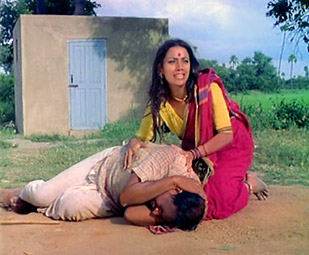
Liberation is highly desired and largely deprived. In 1977 he came out with a brilliantly carved story of a Marathi actress titled ‘Bhumika’ inspired by the book ‘Sangtye Alka’ by Hansa Wadkar and starred Smita Patil in the first major lead role of her career. The film was an excellent portrayal of the complexity of a female mind in a society which drags her in different directions bruising her sexuality and individuality. I must add that Bhumika is one of those rare movies of Indian cinema which has managed to break certain barriers while narrating a controversial and complicated story based on the sexuality and life of Indian woman.
Mahabharata is an everlasting war and a never ending struggle. Nobody could have come out with such an intelligent adaptation of the world’s largest epic ‘Mahabharata’ other than Shyam Benegal who made a multi starrer movie titled ‘Kalyug’ in 1981 with Rekha, Raj Babbar, Shashi Kapoor, Amrish Puri and Anant Nag in lead roles. Kalyug was followed by ‘Arohan’ and ‘Mandi’ in subsequent years.Brothels provide a breathing space to the sexually discontented members of a society which pompously considers marriage an everlasting spiritual and hallowed bonding between two individuals destined to be made for each other. ‘Mandi’ starring Shabana Azmi, Smita Patil, Neena Gupta, Soni Razdan, Ila Arun, Ratna Pathak, Naseerudin shah, Om Puri, Pankaj Kapur, Amrish Puri, Kulbhushan Kharbanda and other geniuses of Indian cinema was a hard hitting satire on the fundamental social, political and cultural inadequacies of our society.
Our present and future are incomplete without the past and howsoever we may try to get away with it, we are ordained to revisit it someday in our lives. It was Benegal’s 1985 venture ‘Trikal’ (Past, Present, Future), again a multi starrer and a striking illustration of the tradition and chores of a soon-to-be-drifted-away Portuguese family settled in Goa.
Following years Benegal got busy with some of the famous television series of his career namely ‘Yatra’, ‘Katha Sagar’ and ‘Bharat Ek Khoj’. Dreams form a momentous and indispensable ingredient in the lives of middle class people and keep them moving ahead in their hopeless and barren existence as human beings. This was the concept of his next important work based on Dharamvir Bharti’s famous novel ‘Suraj Ka Satvan Ghoda’ in 1993 starring Rajat Kapur, Rajeshwari Sachdev, Neena Gupta and Pallavi Joshi in lead roles. The highly experienced cast and talented production team managed to cook up a rich tapestry of semi-dream-like experiences of a young man, entering into adulthood with a creatively written rich and unusual screenplay. In 1994 he came up with a novel project about a loud, vivacious, opinionated and funny, partition stricken woman, ‘Mammo’ with Farida Jalal in lead role. The movie written by Khalid Mohamed was a brilliant take on the mindset of an adolescent boy growing amidst the financial inadequacies of his family and his complex bonding with his old mother and eccentric aunt. ‘Sardari Begum’ directed in 1996 was a story of a popular singer and courtesan killed by a stone thrown by an agitated person starring ‘Kiron Kher’ in title role. ‘The Making of Mahatma’, ‘Samar’, ‘Hari Bhari’ and ‘Zubeida’ were his other noteworthy projects in coming years. In 2005 he directed a biography of Netaji Subhash Chandra Bose starring Sachin Khedekar in title role.
Benegal changed his filmmaking format in following years seeing commercial and parallel cinema merging into each other with the advent of new century. His last two movies ‘Welcome to Sajjanpur’ and ‘Well Done Abba’ were hilarious social satires on the corrupt and inept social and political system of our democratic set up with new age actors like Shreyas Talpade, Rajeshwari Sachdev, Divya Dutta, Ravi Kishan, Boman Irani and Minisha Lamba in lead roles. His latest works have seen him completely transforming as a filmmaker who still manages to amuse and surprise the audiences while keeping the promise of authentic and unconventional cinema alive. Besides devoting himself into directing full length feature films he has also made some of the very important documentaries including ‘ A child on the streets’, ‘Sinhasta’, ‘Why Export?’, ‘The Pulsating Giant’, ‘Tala and Rhythm’, ‘The Shruti and Graces of Indian Music’, ‘The Raag Imam Kalyan’, ‘Suhani Sadak’, ‘The Quiet Revolution’, ‘Epilepsy’, ‘Jawaharlal Nehru’, ‘Satyajit Ray’, ‘Sangathan’, ‘Vardan’, ‘Animal Reproduction and Artificial Insemination in Bovines’ and numerous others stressing the core social issues and forgotten art forms of our country. Shyam benegal is really the master, master of the unconventional.